
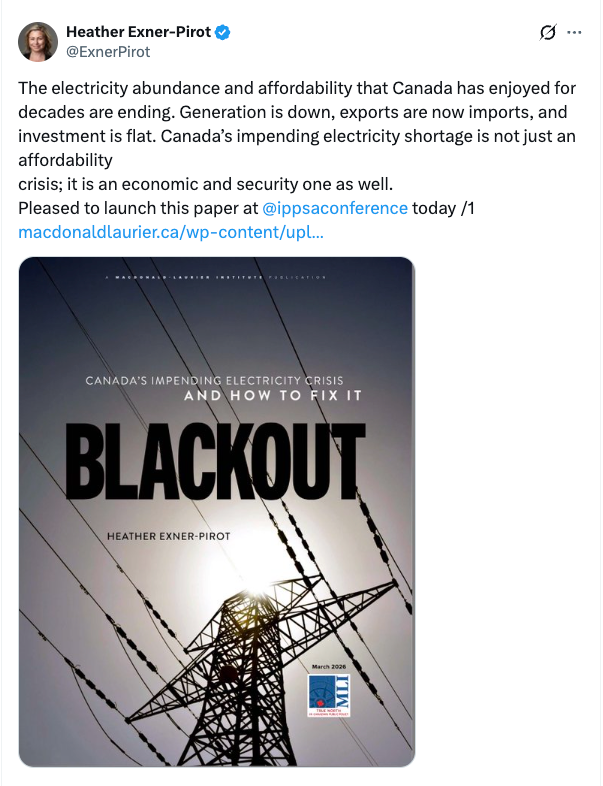
BLACKOUT in all capital, big, black font deliberately dominates the front cover of Heather Exner-Pirot's latest research paper.
"Yes, I wanted it to stand out, to raise the alarm, to sound the alarm that Canada is facing an impending electricity crisis," Exner-Pirot told NowMedia.
"Normal people, taxpayers and ratepayers have to pressure their utility providers and governments for change. I fear it will get worse before it gets better. And any energy crisis becomes a political crisis very quickly."
Calgary-based Exner-Pirot wrote the 54-page BLACKOUT paper for the Ottawa-based Macdonald-Laurier Institute, where she is director of energy, natural resources and environment.
The institute is an independent, non-partisan public policy think tank that advocates for a better Canada.

"If everything was hunky-dory I wouldn't have to write this paper," said Exner-Pirot.
"In 2017, electricity generation peaked in Canada and exports were strong. We definitely exported more than we imported. By 2024, Canada became a net importer of electricity from the US."
Exner-Pirot doesn't blame the situation entirely on poor government policy because some drought years impacted the water flows needed to generate hydro-electricity.
However, the researcher blames government policy for not keeping up with the times.
"Canada has eroded the incredible advantage we used to have with electricity and now it is the bottleneck for our world energy superpower goals," she said.
"Policymakers have to get their act together. It took 10 years to get to this point and it will likely take 10 years to get out of it. I fear it will bet worse before it gets better."
That includes governments making "pragmatic" climate goals.
Exner-Pirot said 80% of Canada's electricity generation can be net zero, but 20% can't.
Burning natural gas to generate electricity is part of the 20%.
"Natural gas has to be part of the solution," she said.
"I'm not saying burn coal. I'm saying use natural gas (which is fairly clean)."
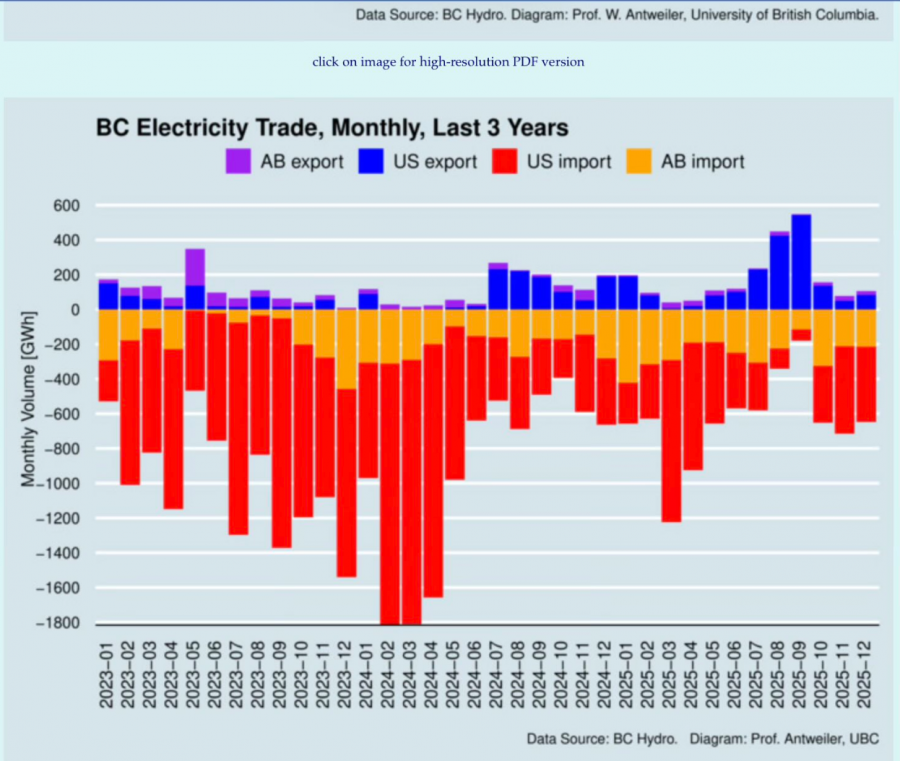
Ironically, BC doesn't allow natural gas to be burned in the province to generate electricity, yet it imports electricity from Washington state and Alberta that's generated from natural gas.
BC and Canada need more electricity than ever before to power data centres (driven by AI) and industries like LNG, mining, steel, aluminum, pulp and paper, chemicals and fertilizer.
"(Electricity) is the foundation of economic growth and material well-being, underpinning productivity, income, health and quality of life," said Exner-Pirot.
"Canada must act now to prevent a looming electricity shortage. This will require pragmatic climate policies, stable and predictable policy frameworks and measures that attract private investment. Governments that fail to address the issue will be punished at the ballot box: voters are ratepayers."
Exner-Pirot's full BLACKOUT paper can be found here.
NowMedia video host Jim Csek and developer and former BC United Kelowna-Mission MLA (2020-24) Renee Merrifield also discussed BC's electricity crisis on their 'Beyond the Ballot' show with the title 'Energy rich, leadership poor'.
"We have to get serious about the different types of electricity that are required" said Merrifield.
"You know, are we gonna go nuclear? Are we gonna go LNG? We need electricity and we need it fast. And we've done as much as we are able to with hydroelectricity. Renewables...are great, but, it's too little, too late. The best thing we could do is use some of our own LNG and actually create some electricity from it. We're already getting electricity that is made with LNG and that's from our Alberta and our Washington (state) neighbors. So it's not less dirty or more dirty than what we're already receiving."