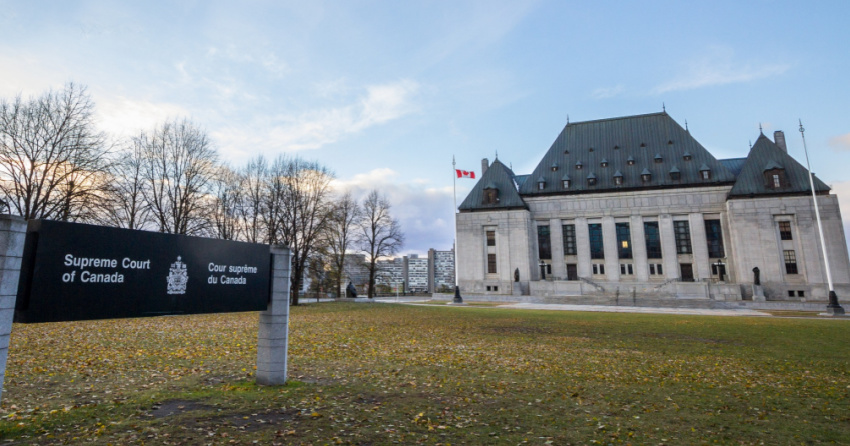
The clock began ticking April 7 on what could be one of the most important Supreme Court of Canada cases in New Brunswick’s history.
That’s the date the country’s top court told several law firms involved in the Wolastoqey Nation’s landmark title claim it would determine if it would allow “leave for appeal.”
Sitting before the black-silk robed justices are eight submitted legal briefs, filed between February and April.
“Leave for appeal” is legal-speak for when the court determines if an appeal should be allowed for a lower-court ruling. In this case, there’s a lot at stake, more than half of New Brunswick’s territory, its western portion and then some.
On one side are First Nations who say they want land restored that was rightfully theirs after colonial double-crossers stole it.
On the other are logging firms and other private property owners who say they’re caught in the middle of a three centuries-old fight that had nothing to do with them.
The Indigenous nation that includes six Indigenous communities in the St. John River Valley wants the Supreme Court to overturn a New Brunswick Court of Appeal decision last December.
That ruling found the nation would have no chance of success in its lawsuit proving that it has Aboriginal title over privately held lands, including the vast holdings of logging companies in the area, most notably industrial giants J.D. Irving and Acadian Timber, and the smaller sawmill firm H.J. Crabbe and Sons.
Instead, the three justices ruled that the federal and provincial governments, or the Crown (a term that goes back to British colonial times), could be held liable for giving away Indigenous land unfairly, leaving so-called innocent parties alone and free to do what they want with the land that they own according to private property rights, or fee-simple law.
By the Court of Appeal’s measure, the Wolastoqey Nation could sue governments for compensation but would have no means to take back control of most of their old territory, now largely in the hands of loggers.
“The New Brunswick Court of Appeal decision that limits our title claim to Crown land is an injustice and stands in sharp contrast to how courts in Ontario and British Columbia are deciding these cases,” said Allan Polchies, the chief of Sitansisk or St. Mary’s First Nation in Fredericton, in a statement released to Brunswick News on Friday.
Polchies leads one of the biggest Indigenous communities in the province, home to about 2,000 registered members.
“It doesn’t make any sense for First Nations in New Brunswick to have more limited rights than elsewhere in Canada. We look forward to the Supreme Court of Canada setting the law straight.”
There have been other Aboriginal title claims in Canada, most notably in British Columbia. The Wolastoqey Nation argues by hearing its case, the Supreme Court could help resolve arguments in those other lawsuits.
The Wolastoqey Nation’s lawyers, led by Renée Pelletier of OKT law firm, argue the appeal should be granted, given the case raises issues of national and public importance.
They want the top court to determine two fundamental questions that they say will affect title claims across Canada.
Can Aboriginal title exist over privately held lands?
Or, quoting the presiding judge, Justice Ernest Drapeau, in the Court of Appeal decision, is it “plain and obvious” that any claim seeking a declaration of Aboriginal title over privately held fee-simple land is bound to fail?
The Wolastoqey legal team says in their application the potential harm caused by the lower court ruling can’t be overstated.
“It means that Indigenous peoples are permanently displaced from fee-simple land. Only this Court can decide whether that outcome is correct. Now is the time for this Court to address the issue, given that the decision of the court below is demonstratively at odds with how courts in other provinces have chosen to reconcile Aboriginal title and fee simple rights.”
They say the confusion created by these different approaches will inevitably impact litigation and reconciliatory negotiations across large swathes of the country, wherever governments have sold Indigenous lands without their say so.
Canada has more than 600 First Nations.
Several interveners have applied in support of the Wolastoqey, including Elsipogtog, New Brunswick’s biggest Indigenous First Nation an hour’s drive north of Moncton, and eight other Mi’kmaq communities on the province’s eastern side. They have their own Aboriginal title claims making their way through the courts.
JDI, which has hired a big legal team to bolster its case, argues in its brief that the Wolastoqey Nation’s case isn’t the right one for the Supreme Court to hear.
Instead, the firm’s lawyers, led by experienced litigator Paul Steep of McCarthy Tétrault in Toronto, say it would make more sense for the top court to wait until the Cowichan Tribes case in Richmond, B.C., and others come before the nine justices.
The Cowichan case is already under appeal to the B.C. Court of Appeal, after a lower court last year gave the First Nation Aboriginal title over some of Canada’s most expensive private property, worth more than $2 billion, including a port terminal, airport jet fuel facilities, several other businesses and residential properties, all on Lulu Island in the city just south of Vancouver.
The decision after the longest trial in Canadian history created shockwaves in British Columbia, with private property owners howling they could be robbed.
Premier David Elby has promised to fight it all the way on behalf of private owners.
The JDI lawyers argue the Wolastoqey Nation’s case is still in its early days, and the decision of the New Brunswick Court of Appeal was a procedural ruling before a full-throated defence had even been mounted.
They say it’s much too soon for the Supreme Court to weigh in on the merits of the Aboriginal title claim.
“The issue that Wolastoqey Nation seeks to raise – specifically whether Aboriginal title can exist over privately held lands – was not decided by the Court of Appeal,” they wrote in their legal brief, adding the Dec. 11 judgment “was a simple exercise of error correction by a provincial appellate court, applying uncontroversial principles of procedural fairness.”
Legal experts say the Supreme Court normally takes between one or two months to decide whether it will hear a case in the “leave for appeal” process.
However, depending on how complicated or controversial the topic is, it can take longer. A screening panel of three of the nine justices on the court will determine if the case should be heard or not.
They typically don’t give reasons for the decision.
If the appeal goes ahead, the full Supreme Court could hear the case as early as this fall or more likely next year.