
The union for workers at Jim Pattison-owned Save-On-Foods says it has raised concerns about another Pattison company’s sale of a Virginia warehouse for use as a detention centre for US Immigration and Customs Enforcement, or ICE.
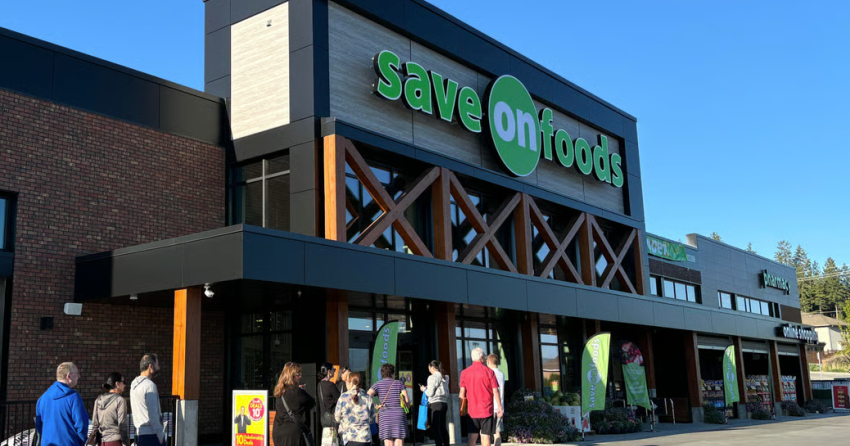
But United Food and Commercial Workers Local 1518 president Patrick Johnson said that while his union condemns the actions of ICE, boycotting Save-On-Foods could hurt employees.
“Frontline grocery workers in British Columbia have no control over decisions made by Pattison Developments,” Johnson said in an email.
“Shifting the impact of these developments onto workers — through boycotts that reduce hours or income — places the burden on people with the least ability to absorb it.”
UFCW Local 1518 also stands with workers in Minnesota, the union said.
B.C.-based real estate company Jim Pattison Developments is in talks to sell a warehouse in Ashland, Virginia, to ICE. Save-On-Foods is also owned by B.C. billionaire Jim Pattison, through a separate company called Pattison Food Group. The privately owned company reports $19 billion in annual revenue.
Jim Pattison Developments said in an emailed statement that it accepted a U.S. government contractor’s offer to buy the warehouse but was not aware of the “ultimate owner.”
News of the sale inspired some B.C. residents — including BC Green Party Leader Emily Lowan — to call for a boycott of Pattison-owned businesses until the company backs out of the deal.
The Jim Pattison Group owns a wide range of businesses across Canada, including the Jim Pattison Auto Group, the Niagara Falls location of Great Wolf Lodge and grocery stores like Save-On-Foods, PriceSmart Foods and Choices Market. In B.C., Save-On-Foods is the most visible and common symbol of Pattison’s business empire.
The boycott suggestion comes as ICE’s deportation push becomes increasingly violent. This month, ICE agents have shot and killed two U.S. citizens, Renee Good and Alex Pretti, and detained a five-year-old child alongside his father.
Meanwhile, pressure is growing in Canada for businesses to cut their ties with the agency.
B.C. Attorney General Niki Sharma said at a press conference Tuesday that Canadian companies should consider how decisions affect the outcomes unfolding in the United States.
“Just like the rest of the world, we watch in horror about what’s happening there,” she said. “That calls on business leaders across this province, and including the whole country, to think about their role in what is unfolding there.”
Johnson said UFCW Local 1518 “strongly condemns practices that dehumanize people or subject them to harmful or degrading treatment, in the United States or anywhere else, including those documented by victims of ICE.”
“Business decisions that result in the expansion of detention centres raise legitimate questions about dignity and fairness.”
The company said in an emailed statement that it built the Ashland, Virginia, warehouse for company operations in 2024.
According to the emailed statement from Jim Pattison Developments, after the company decided it no longer needed the warehouse it listed the property for sale and accepted an offer to sell it to a U.S. government contractor.
The company says it only later learned the building would go to ICE, which plans to turn the 550,000-square-foot warehouse into an immigrant processing facility amid an aggressive deportation push.
“We understand that the conversation around immigration policy and enforcement is particularly heated, and has become much more so over the past few weeks,” the unsigned statement reads. “We respect that this issue is deeply important to many people.”
The company said it plans to follow the law while continuing to sell the warehouse and that the transaction still has to go through approvals and closing conditions.
It did not specify what those conditions were.
“Please note that we will not be providing any further comment at this time,” the company wrote to The Tyee.
Rajiv Krishnan Kozhikode, an associate professor at Simon Fraser University who researches corporate political activity, said it’s unclear whether the business is responsible for ICE bidding on a public offer of sale.
“It’s a bit of a grey area there to say that they should be responsible,” he said, adding the Department of Homeland Security may have made the highest bid on the warehouse or another bidder may have turned over the property to ICE.
“The first principle of business is staying profitable,” he said. “If you have a business which is not making profits, you want to give it to the highest bidder.”
Kozhikode said the onus fell to the government. He said if Canadians don’t want Canadian businesses working with ICE, it’s up to the government to implement trade sanctions — instead of negotiating better trade deals.
“The way ICE is dealing with some people, killing its own citizens, the way they are treating immigrants, even detaining children — it’s really bad,” Kozhikode said.
“Had it been any other country, we’d have asked [companies] to stop doing business with that country. We didn’t.”