
British Columbia’s NDP government tabled a 2026 budget on Tuesday that raises personal income taxes at the bottom bracket for the first time in a generation, trims public-sector staffing and slows parts of its capital plan, while projecting a record deficit of $13.3 billion next year.
At a glance, Budget 2026 changes:
Income tax: raises the lowest personal income tax rate by 0.54 percentage points to 5.6%, offset partly by a B.C. tax reduction credit.
Deficit: forecasts a $13.3-billion shortfall in 2026-27, then $12.2 billion and $11.4 billion in the following two years.
Staffing/savings: targets a reduction of 15,000 public-sector full-time-equivalent positions over three years and $3.5 billion in “expenditure management” savings; the core public service shrinks by 2,500 positions largely through attrition.
Capital plan: “re-paces” spending, lowering next year’s capital spending to $18.7 billion (down from a prior forecast of $20.4 billion) and delaying several projects, including long-term care facilities, Phase 2 of Burnaby Hospital and Cancer Centre, and University of Victoria student housing.
Taxes beyond income: expands PST to some professional services, pauses bracket indexing from 2027 to 2030, and raises certain housing-related taxes on higher-value properties and non-resident/“untaxed worldwide” owners starting in 2027.
Finance Minister Brenda Bailey framed the plan as “serious work for serious times,” adding: “It’s our time to take a pause on some of the things we want to do, to do the things that we need to do.”
The budget lifts the bottom income-tax rate to 5.6 per cent for taxable income up to $50,363. Government staff say about 60 per cent of filers will pay more, with an average increase of $76 in 2026, while more than 40 per cent would see savings once the tax reduction credit is increased. The budget documents say the maximum impact is $201 for people earning more than $140,000 who do not qualify for added credits.
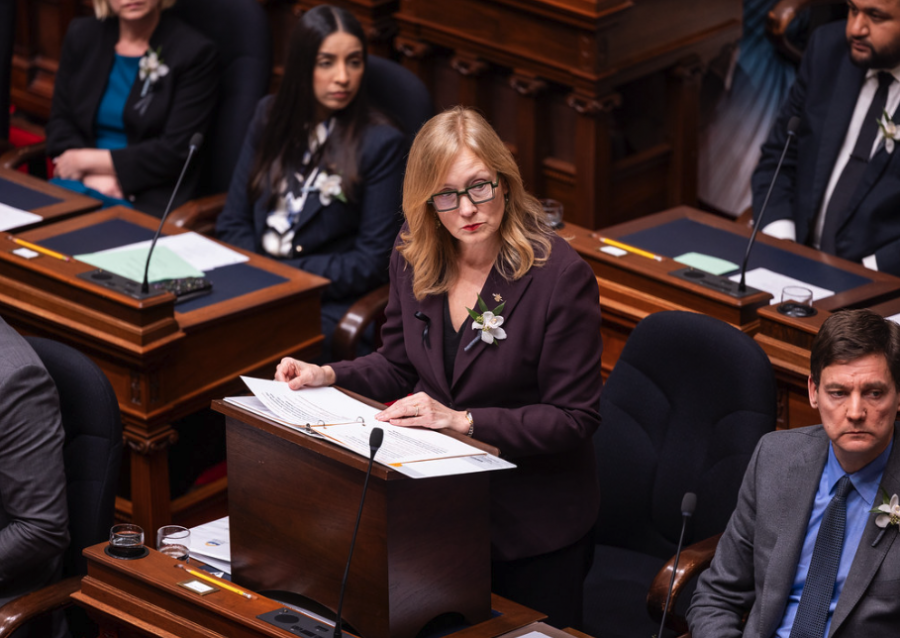
Bailey argued the move is a long-term revenue fix. “We are updating the tax system to raise revenue and prevent cuts to critical services,” she said in the government’s news release, adding the province is “making careful choices to secure B.C.’s future.”
Even with new revenue measures, the budget projects the deficit will climb by about 38 per cent next year, to $13.3 billion, from an updated forecast of $9.6 billion for the current year. The province said that improvement from earlier projections reflects higher corporate and personal income-tax revenue, lower spending on refundable tax credits and a one-time $2.7-billion tobacco settlement.
The fiscal plan also targets savings through a smaller public sector and tighter spending controls. The government says it will reduce public-sector staffing by 15,000 full-time-equivalent positions over three years while “protecting front-line services,” and it will set “specific targets to reduce the number of executive positions,” focusing on Crown corporations and the health sector. The B.C. public service is expected to shrink by 2,500 positions, mainly through attrition and voluntary departures.
At the same time, the government says it is “strategically resequencing” parts of its capital plan. Capital spending is set at $18.7 billion next year, down from a previously forecast $20.4 billion, and projected to fall to $16.1 billion by 2028-29. The changes include delays to construction of seven approved long-term care homes, Phase 2 of Burnaby Hospital and Cancer Centre, and student housing expansion at the University of Victoria.
“These are not cancellations,” Bailey said, calling it “a recognition that the province needs to strategically resequence projects to address fiscal pressures.”
The budget also broadens the provincial sales tax to include some professional services and removes certain PST exemptions. It pauses tax bracket indexing from 2027 to 2030, and raises the speculation and vacancy tax for foreign owners and “untaxed worldwide earners” to four per cent for the 2027 tax year. It also increases the additional school tax on luxury homes worth more than $3 million beginning in 2027.
Opposition parties and stakeholders criticized the plan’s mix of tax hikes, deferred projects and continued deficits. Conservative finance critic Peter Milobar called it “an assault on seniors, working families and the small businesses that drive our economy,” while the Green Party said the budget was “built on the backs of British Columbians — and it is crushing them.”
Business groups also questioned the fiscal trajectory. Business Council of B.C. vice-president David Williams said, “We’ve got about $4 billion in the budget in tax increases … and that’s really concerning, because the private sector is already very, very weak.” Greater Vancouver Board of Trade president Bridgitte Anderson said the province was on “a perilous trajectory,” pointing to debt growth despite higher taxes.
The government’s plan emphasizes maintaining service funding while tightening overall growth. It points to $5.1 billion in added funding over three years for health care, K-12 education and social supports, including $2.8 billion for the health-care system, $634 million for K-12 education, and a $330-million “lift” to stabilize ChildCareBC. Bailey said the budget “is not about ‘new, shiny programs.’”
Seniors Advocate Dan Levitt warned the long-term care construction delays could have real knock-on effects. “It’s going to put pressure on the family caregivers, people who should be in the workforce, who are now caring for that senior,” he said. “(It’s) also going to create a situation where the seniors are not getting the kind of care they should be.”
The province said it expects deficits to decline over the plan period, and it highlighted a projected drop in the deficit-to-GDP ratio from 2.9 per cent in 2026-27 to 2.3 per cent by 2028-29.
Bailey insisted she remains focused on the bottom line: “Nobody worries about the deficit more than I do,” she said.