
Canada’s economy stalled in the first quarter of 2026, as higher imports, weak investment and softness in some key industries offset household spending and inventory gains.
Statistics Canada says real gross domestic product was unchanged in the first quarter, following a 0.2 per cent decline in the fourth quarter of 2025, meaning the national economy is now in a technical recession.
The flat reading means real GDP has now failed to grow for two consecutive quarters, though the data show a mixed picture of the economy.
The agency says higher imports of goods, particularly gold, weighed on growth, while accumulations of business inventories helped offset the drag.
On a per-capita basis, real GDP rose 0.2 per cent in the first quarter, as Canada’s population declined for a second consecutive quarter while overall output was unchanged.
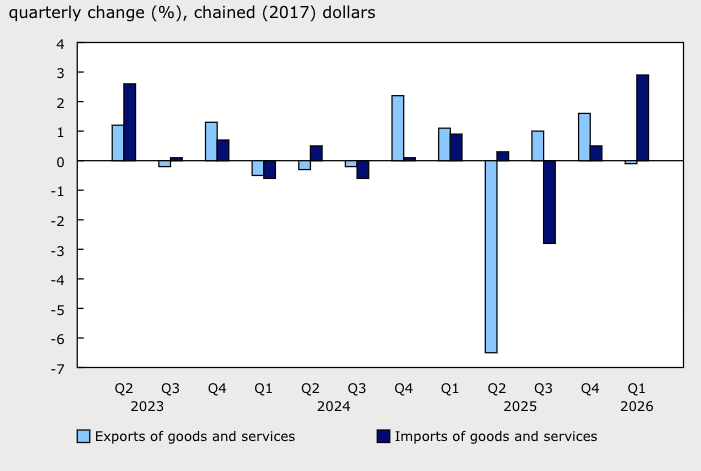
Imports rose 2.9 per cent in the quarter, with roughly half of that increase coming from intermediate metal products and waste and scrap metal, both driven by gold imports. Excluding those categories, imports rose 1.2 per cent, led by passenger cars and light trucks as well as industrial machinery and equipment.
Exports edged down 0.1 per cent after rising 1.6 per cent in the fourth quarter. Statistics Canada says the decline was led by fewer exports of passenger cars and light trucks, which have been affected by U.S. tariffs.
That decline was largely offset by higher shipments of crude oil, crude bitumen and natural gas.
Business capital investment fell 0.7 per cent in the first quarter, marking a fifth consecutive quarterly decline. A sharp drop in investment in engineering structures more than offset higher spending on machinery and equipment, mineral exploration, non-residential buildings and software.
Residential investment also fell, dropping two per cent after a 2.4 per cent decline in the fourth quarter. The agency says the weakness was led by continued softness in resale housing activity, while new residential construction edged down 0.1 per cent.
Government capital investment fell 2.5 per cent after strength through much of 2025, mostly due to lower investment in weapons systems compared with the elevated level recorded at the end of last year.
Household spending provided some support, rising 0.4 per cent in the quarter. Growth was led by higher spending on financial services and food, though fewer Canadians travelling abroad and lower purchases of new vehicles limited the increase.
Final domestic demand, a measure of spending by households, governments and businesses, edged down 0.1 per cent.
The GDP deflator, a broad measure of economy-wide prices, rose 1.1 per cent, led by higher export prices following the global rise in oil prices. Export prices rose 3.4 per cent, while import prices increased 1.1 per cent.
Statistics Canada says the terms of trade improved 2.3 per cent, reflecting the stronger increase in export prices compared with import prices.
Employee compensation rose 1.2 per cent in the first quarter, led by gains in professional and personal services, health care and social assistance, and retail and wholesale trade. Those increases were partly offset by declines in federal government public administration and finance, real estate and company management.
Compensation rose in every province and territory, ranging from 0.7 per cent in Quebec to three per cent in Yukon.
Corporate incomes rose 1.6 per cent, marking a third consecutive quarterly increase. The energy sector led the gains as global energy prices rose sharply, while financial corporations also posted stronger operating surplus tied to investment services and fee income.
The household saving rate fell to 3.5 per cent, its lowest level since the first quarter of 2024. Statistics Canada says disposable income rose 0.6 per cent, while nominal household consumption increased 0.9 per cent.
The agency says household investment earnings declined, while interest payments rose for the first time since the second quarter of 2024.
Statistics Canada says its early estimate for April points to a rebound in real GDP, with growth of 0.4 per cent for the month as mining, quarrying and oil and gas extraction returned to growth.