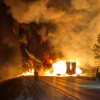
Last year’s fire season was a busy one in Peachland, with three significant wildfires near the town.
And with not much winter precipitation and local forests already very dry, the 2026 fire season could be shaping up the same way, said Peachland Fire & Rescue chief Ian Cummings.
“I definitely have some concerns about the upcoming summer and the drought conditions we have and wildfire possibilities, so that's always on our minds here,” said Cumming.
The amount of rain Peachland receives in late spring and early summer is a big factor, but either way fire season is getting longer. “Last year was relatively mild, and then it really hit us late in the season, more into late August, September,” he said.
The fire department played a role fighting three significant fires in 2025: on Drought Hill, Peachland Creek, and the Monroe Lake fire. Cummings said they work well with the B.C. Wildfire Service, partly because they’ve become very well-rehearsed in recent years.
“We set up a unified command quickly, which means that we brought in senior people from all the different agencies and years of practice unfortunately through necessity has made things a lot smoother. B.C. Wildfire is great to work with. They come with a lot of resources if available and we integrate into their system really well.”
Cummings said other partners like West Kelowna, Kelowna, and the RDCO provided resources, both apparatus and manpower. “And it's reciprocal so when something happens in one of the other neighbouring communities, we will be providing that same kind of assistance,” he said.
Peachland has many homes and structures that were built in the interface between urban and forest, said Cummings, and that’s one of the challenges for fighting wildfire. Peachland’s hilly terrain makes ingress and egress an issue, but he said future urban development is well-regulated in terms of the threat from wildfire.
“I think we've got some pretty good rules and regulations around hillside development bylaws and incorporating FireSmart principles into developments. We've come a long way over the last number of years. I think we've got a ways to go still but we're certainly trending in the right direction,” Cummings said.
Peachland’s fire department has a contingent of 34 firefighters and while they are trained to fight structure fires, combatting wildfires is also a key part of their preparation, which was not always the case in the past, Cummings said. He also said the coming of spring means an intensive training and retraining period.
“I would say that there's a lot of priority given to training our staff on wild and interface fires. Springtime is always new courses for new members, maintenance training for existing members. refreshers, and we send members out to regional and provincial courses. But it's like any anything, when you get a large fire, whether it's a large structure fire or a large wildland fire, they're all different. They bring their own sets of challenges,” said Cummings.
Peachland’s firefighters are what’s known as paid on-call firefighters as opposed to full-time salaried career firefighters, which how larger municipalities’ fire departments are staffed. Cummings said a major wildfire is challenging for paid on-call firefighters because they have full-time jobs elsewhere that they need to be able to leave behind. If it’s a big wildfire, that can be days or weeks.
“For the paid on-call members the biggest issue with the large interface fires is the amount of time away from their work. Because they have a main job, whereas a career firefighter, that is their job. So, it's different if they’re just leaving their work or their home for two hours, maybe three hours to respond to a car accident or a medical call. They’re taking off now maybe a week or maybe a week and a half to fight a wildland fire. They've got to balance that.”
Their paid on-call status means Peachland’s firefighters do receive some remuneration, but Cummings said it's often much less than what they would earn at their full-time places of employment.
New gear is also on the horizon for the fire department for 2026. Cummings said he’s reasonably confident that a $30,000 grant application from the Union of BC Municipalities will come through. Some of the funds would go to new turnout gear, with the remainder earmarked for a new dryer that can dry heavy protective clothing in 90 minutes rather than a couple of days. Clean and dry gear is a workplace safety issue too, Cummings said, because of frequent exposure to cancer-causing contaminants.
“Our members wash their gear quite a bit. It’s a decontamination item because cancers in the fire service are well understood now, much better than before, and so we're getting our members to wash their gear after exposures,” he said.
What can Peachlanders do to prepare for what could be difficult fire season? Cummings said they can reduce the risk to their properties and their neighbourhoods via the FireSmart program, or if they’ve already done some of that work, rededicate themselves to it.
“We need everybody to get on board, and not just following FireSmart principles one year and then forgetting about it. This is a constant thing that needs to be addressed. Every year you have to look at your property and do some work and make sure it doesn't get away on you,” he said.
Contact the Peachland FireSmart team at [email protected] for information, or go to the provincial FireSmart website at firesmartbc.ca.