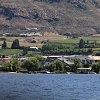
If you get onto Naramata Road and keep driving several kilometers past Naramata itself and then past the turnoff to Chute Lake and continue 'til you basically can’t go any further, you'll inevitably hit a fork.
To the right, the road is private. And it's dirt. So don't go that way. But to the left is Indian Rock Road, a scenic roller coaster plunge downward to the most northerly human settlement on the east side of Okanagan Lake before Kelowna.
Fittingly, the tiny community at the bottom is called…you guessed it…Indian Rock.
It's here, in this small grouping of homes that a collection of locals, backed by entities like the Penticton Indian Band, the Okanagan Nation Alliance Fisheries and the Regional District of Okanagan-Similkameen, is battling to correct an issue they say has been percolating for years.
It all has to do with a little creek and its penchant for occasionally becoming a very big creek, and the decades-old human efforts to control it. Efforts they claim are now causing more harm than good.
The waterway in question is known as Chute Creek. It originates in the watersheds of the mountains to the east and zig-zags toward Okanagan Lake, cutting through the southern edge of the Indian Rock village in the final stretch before hitting Ogopogo's home.
Near the very end, within sight of the shore, it crosses under a bridge on Indian Rock Road. It's this section of the creek in particular – essentially the 125 or so meters from the Indian Rock Bridge to the lake – that's currently the subject of so much scrutiny.
It is, says a fellow by the name of Peter Moritifee, a serious and exceptionally complex situation that needs resolution.
Mortifee, an Indian Rock resident whose home and property borders on Chute Creek just past the bridge and is therefore right in the midst of the perceived problem area, is co-founder and chair of a charitable organization founded in 2018 called the Chute Creek Stewardship Society (CCSS). It’s their mission to create awareness of all the issues at they feel ar at play and ultimately find a solution.
And one day in late 2023, Mortifee stood with PentictonNow on the Indian Rock Bridge and tried his best to summarize a complex scenario.
At the forefront is a problem that's been repeated ad nauseum throughout the Okanagan and indeed throughout the west in general – the mistaken old-school belief that "channelizing" bodies of running water is a smart move. For the most part, it isn't.
A prime example of channelization running amok can be found in Penticton's own Penticton Creek, which in the 1950s was constrained in an effort to deal with a spate of major floods.
In the years since, spawning fish have been unable to navigate the fast-moving water and much of the concrete has deteriorated. And now, the creek is in the midst of a multi-year, high-tech restoration project costing more than $30 million that will not only reverse man's impact on spawning fish but also decrease the risk of future floods.
According to Mortifee, a similar situation currently exists in the final 125 meters of Chute Creek. And the chief culprit is a concrete channel that was installed between the bridge and the shore in the 1960s.
"So basically where we are right now," he said, still standing on the bridge, "is at the apex of an ancient alluvial fan that was created by Chute Creek over the course of thousands of years."
Mortifee explained that an alluvial fan is a triangular-shaped deposit of sand, gravel and assorted materials that gradually accumulates at the mouths of certain waterways.
In the case of Chute Creek, that alluvial fan, and the many threads of water that trickled from the creek to create it, stretched almost a half-kilometer across the Okanagan Lake shoreline.
It was a gentle place where slow-moving water from the creek entered the lake and blended with aquatic greenery to make a friendly environment for returning and spawning fish. Fish like kokanee salmon, sockeye salmon and rainbow trout.
"But 60-plus years ago," he continued, "a developer came along and said we'll take this creek and constrain it into a concrete flume. The idea being that all the land on the alluvial fan could be developed if the creek water wasn’t allowed to behave naturally."
The flume/channel was soon constructed and it wasn't long 'til development began, including on the land that would eventually become Mortifee's current property.
"But the (unintended) consequence," said Mortifee, now showing us the spot on the shoreline where the decades-old channel empties into the lake, "was complete destruction of the natural ecosystem of the area."
"When this went in, the fish stopped coming up," he said. "They can’t come up the way it is now. The water is too fast, the food they need isn't there. The materials they need to lay their eggs aren’t there."
Adding fuel to the fire, the aging channel is breaking apart. Mortifee showed us the sites of several recent repairs and then numerous large, broken sections of concrete that have collected at the mouth.
"This flume, as you can see, has had multiple repairs over the years," he said, "including major repairs in 2018 and 2019 after the floods of 2017 and 2018. Chunks of concrete are in the lake. Sections of the land have eroded.
"We've had two engineering companies tell us it's at the end of its natural life, that it must be replaced. And we’ve done some patching to buy us more time."
Beyond all of that, the water flowing through it has occasionally crested it and spilled over onto adjoining properties (there are 11 in all on the footprint of the alluvial fan). Mortifee expects such flood threats to increase due to the tough reality of climate change.
But, he says, his organization doesn’t want the channel saved or rebuilt. They want it gone. Permanently.
In its place they want to build a system that seemingly does the impossible. It would keep all the creek water within the approximate current boundaries, it would protect the immediate area from flooding, and it would make use of both natural and human-engineered materials to soften and naturalize the flow of water, thus returning lower Chute Creek to the spawning hotbed it once was.
They say they can do it, though they also admit it’s a massive job that'll cost a lot of money. Money they're currently searching down.
But wait. There's more. According to Mortifee, there's yet another piece to the overall equation that must be solved before any other remediation can start.
It's the bridge itself. And, says Mortifee, it's the key to the entire puzzle.
Just about every year, he said, there's a time when the water traveling under the Indian Rock Bridge reaches flood conditions. Most often it'll hit the underside of the bridge or wash over the top, and occasionally it'll get downright wild, surging over the bridge and making it impassable for hours or days.
And then it runs down the road and floods the properties in that direction.
Considering that Indian Rock Road is the only vehicular artery in the area, a bad flood means the homes on the south side – there are eight of them – are effectively cut off and under the threat of flood for the duration.
And, he maintains, it's only a matter of time until the bridge and/or its support system is seriously damaged. Or dislodged.
"We had a big flood in 1990 and two more in 2017 and 2018," said Mortifee. "And with climate change, we expect more. So the reality is that this bridge is not adequate to protect this community from flooding and needs to be upgraded."
And this is precisely where an already intricate issue becomes crazily complex.
Why? Because, say Mortifee and the CCSS, whatever changes are made at the bridge will impact everything below it. So none of their planned reparations for the final 125 meters of Chute Creek, none of the stuff we've discussed in the first 1500 words of this article, can be enacted until the bridge is dealt with.
What’s more, the bridge issue introduces an entirely new entity to the situation – the Ministry of Transport and Infrastructure. It has the final say at that specific spot. And it has yet to give an indication of its plans.
"Right now," said Mortifee, "the bridge, based on the engineering firm the Ministry hired to assess capacity, is rated as a '1-in-2 two year event bridge,' meaning that once in every two years on average, it'll get over-topped.
"But the current standard is at least 1-in-100 years. So the Ministry doesn’t know yet what needs to be done. Do they raise the bridge? Do they make it wider? Do they dig deeper underneath it?
"And we're saying let's design something that'll optimize the water flow conditions so we can restore the ecosystem at the same time."
Fortunately, the CCSS seems to have made a lot of friends along the way – friends that should be of some assistance as they plunge ahead.
Friends like the Penticton Indian Band, which has completed a cultural heritage and resource assessment on the site and has helped review restoration goals. And the Okanagan Nation Alliance Fisheries, which is involved in the CCSS's conceptual design process.
"We’ve also had support from the Pacific Salmon Foundation," said Mortifee, "because they want to see the salmon come back. And we're being supported by the Okanagan Basin Water Board because they’re interested in the quality of water and the RDOS, which supported us from the beginning."
Going forward, Mortifee hopes 2024 is the year when all the planning and prep finally begins to translate to action.
"We've been at this for seven years," he said. "The land owners of the five lots adjacent to the creek have come to a written agreement on basically how we'll move ahead, and we had an expert in the field, Mould Engineering out of Kelowna, complete the initial inspection and remediation report. They'll be the project manager."
As for total cost, Mortifee speculates it’ll run "well into the seven figures."
But he's certain it's worth it. Not just is a local sense either. He believes lessons learned at Chute Creek will be of intrinsic value elsewhere.
"The issue of dealing with water infrastructure that was designed in the middle of the last century and is beginning to fail is something a lot of communities are facing," he said. "Peachland, Trout Creek, Penticton Creek, Mission Creek…we're a micro example of a macro issue."
To learn more or to contact or donate to the Chute Creek Stewardship Society, head to their website here.