A North Vancouver high school student has developed a solar-powered portable medical kit to enhance health care in remote and underserved areas.
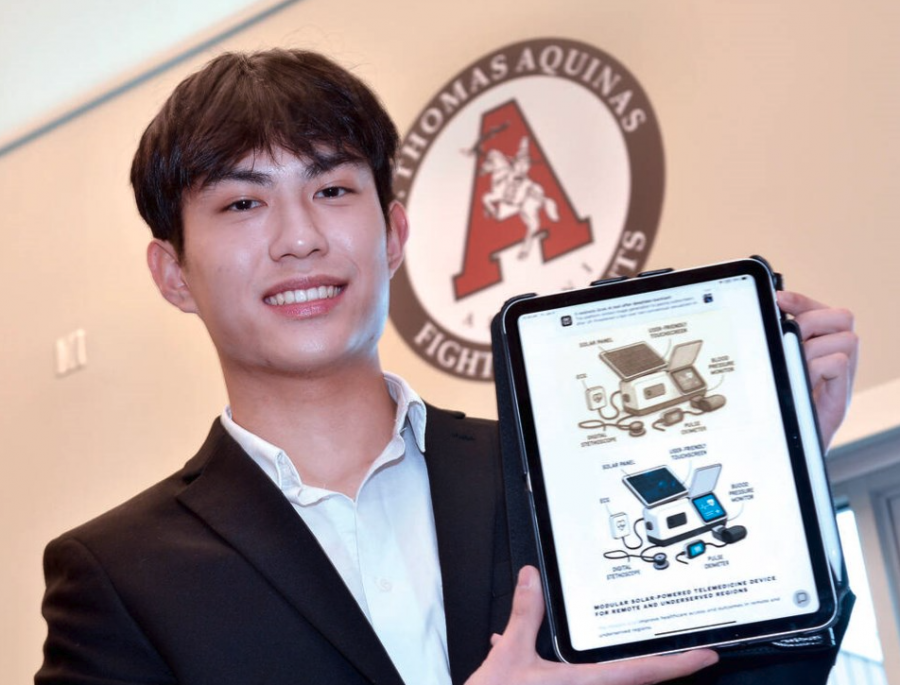
Grade 12 St. Thomas Aquinas student Jonathan Weng created the “solar power telemedicine device,” a medical kit with a digital stethoscope, pulse oximeter and blood pressure monitor. An ultrasound machine or microscope can also be attached to the kit, allowing those devices to function in areas without reliable electricity.
Weng spent the last 18 months designing the device in his North Van home, all outside school hours. After detailed planning, Weng will deploy the device in a pilot project in Kibera, Kenya in March with the United Cultural Empowerment and Social Community Organization (UCESCO) Africa.
“I wanted to help find a solution,” Weng said about what motivated him to work on this project. “We want this to be a device that anyone can use regardless of any socioeconomic challenges or even knowledge barriers.”
Weng said the aim of the pilot is to help identify areas that need refinement and prepare the device for broader implementation.
The medical device idea was inspired by Weng's first trip to Kibera two years ago with UCESCO-Africa, where he shadowed doctors and dentists while also teaching at an elementary school. While volunteering, Weng saw a child being turned away from a clinic because a power outage damaged the diagnostic equipment. The incident sparked the idea for a solution.
“I went back to North Van and decided I wouldn’t let that happen again. This isn’t about charity, it’s about building systems that work when everything else fails,” he said.
Since then, Weng has travelled to Kibera annually to help people get medical care.
“I witnessed so many health-care inequities that people face on a daily basis,” he said, referencing lack of developed infrastructure supporting electrical technology, where clinics and neighbourhoods can face blackouts when it rains.
Weng said that his medical device differs from donations supplied by clinics and laboratories across North America and Europe because it would still work during a blackout as it doesn't require electricity to function. The device can run on solar power and also has a hand-crank generator to sustain operations.
“It's pretty accessible for almost anyone to use. It allows a local worker to run diagnostic tests, get AI analysis or to send the data to the specialists in the city,” Weng said, which would be Kenya’s capital Nairobi.
Since the trip, Weng has become an advocate for global health, earning credentials as a registered emergency medical responder in B.C. and an emergency medical technician in the U.S. He is also the author of four published books and founder of Youth Advocates for Global Health Association, which aims to address global health disparities and empower underserved communities, according to its website.
The first trip to Kibera was a turning point for Weng.
“I used to take everything for granted,” Weng said. “I wasn’t a very considerate person back then, which is probably one of the reasons why my parents wanted me to go out there and see what it’s like. So I really say that trip itself, that three week trip for the first time, it really changed how I viewed the world in general.”
Weng said that the device has recently gained recognition on a global scale. His project has advanced to the evaluation stage of the 2026 MedTech Accelerator Program, a global competition that helps support medical technology startups. Participating in the program will offer exposure to investors, mentorship and guidance to further develop the device.
“I want to keep improving this product, help try to get it to the highest level it can be so that people who benefit from this product get the best possible care,” he said.
Abby Luciano is the Indigenous and civic affairs reporter for the North Shore News. This reporting beat is made possible by the Local Journalism Initiative.